The Anyport Team
Introducing Anyport: push to deploy on clusters you already own
A deploy platform for the Kubernetes clusters you already run: builds, rollbacks, domains and HTTPS from one console, with compute on your own clusters never metered.
Update, 2 October 2026: three clusters are now free, and Pro is $5 a month with $5 of credit back. The current prices are on the pricing page.
There are two decent ways to ship a backend service today, and both cost you something.
You can hand the whole problem to a hosted platform. The developer experience is excellent, and you stop thinking about infrastructure. In exchange, someone else owns the machines, your data lives where they choose, and every container, build minute, and gigabyte shows up on an invoice that grows with your success.
Or you can run it yourself. You keep control and the hardware is already paid for, but now somebody on your team owns YAML, ingress, certificates, secrets, and the pager. That person is usually your best engineer, and this is not what you hired them for.
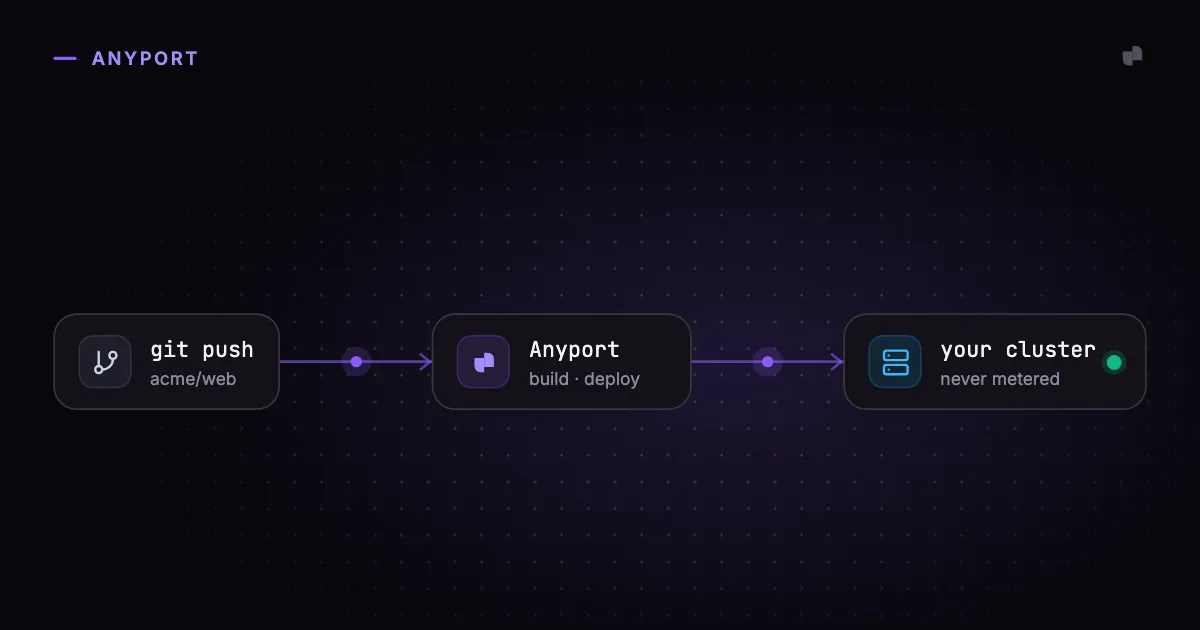
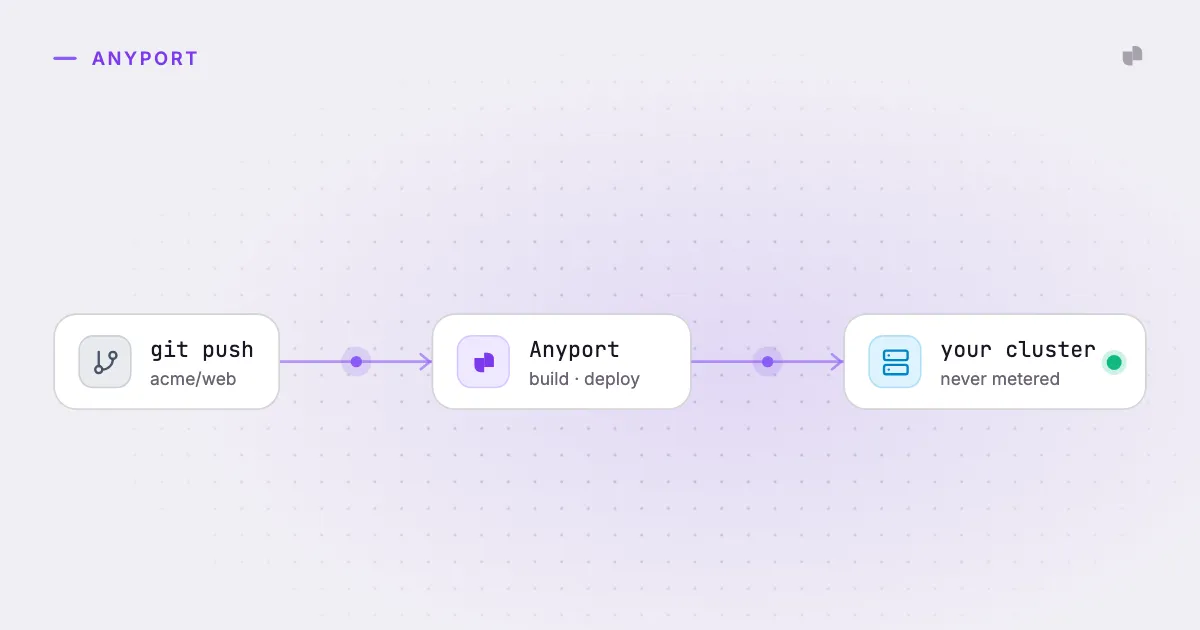
Anyport is the third option. Connect a Kubernetes cluster you already run, point a project at a GitHub repo, and push. You get the workflow of a hosted platform on infrastructure that stays yours. If the machine is bare, one command installs k3s first.
What that looks like
- Push to deploy. Connect a repo once. Every push builds and rolls out. There is no pipeline to wire up, and the build runs on your own cluster.
- Deployments you can undo. Every release is a versioned revision, with the full history in one timeline. A bad deploy is one click away from being the previous one.
- Projects, not namespaces. Dev, staging, and prod are separate projects with their own apps, config, and secrets. Duplicate one when you need an exact copy, or save it as a template to spawn more later.
- Domains and HTTPS. Every app gets a URL the moment it deploys. Attach your own domain and certificates are issued and renewed for you.
- Managed services. Add PostgreSQL, MySQL, MongoDB, Redis and more to a project in one click, and bind the connection details straight into your apps. Point a database at an S3-compatible bucket you own and it takes scheduled backups there and keeps the history. Metrics and logs install once per cluster and collect from every project on it.
Your compute is never metered
This is the part we'd most like you to check. Your apps, builds, logs, and metrics all run on hardware you already pay for. That costs us nothing, so we don't charge for it: there is no per-container, per-build-minute, or per-gigabyte-of-logs line item, and there won't be one.
Update, September 2026: this still holds for every cluster you attach. Anyport Cloud, which runs a cluster for you on our hardware, is the exception, and is billed for what it uses from prepaid credit. The rates are on the pricing page.
What we would charge for is the control plane and the front door: the dashboard across every cluster you connect, the roles and audit log on top of it, and the gateway that publishes apps from clusters with no public IP. Traffic served directly by your own load balancer never passes through us and is never counted.
The connection only goes one way
You install an agent that only makes outbound connections. No open ports, no exposed API server, no shared kubeconfig. And underneath the console, everything Anyport creates is a standard Kubernetes object you can inspect and keep. If you stop paying us tomorrow, your apps keep running, which is the only version of "no lock-in" worth the words.
Where we are
Anyport gives you one cluster free with every feature, and Pro is $5 a month for three. The one resource counted is traffic our gateway carries for a cluster with no public address of its own. If you have a cluster running and a repo you are tired of deploying by hand, that is exactly the case we built this for. Tell us how it goes.